
Research Highlights
"Can Physics be simulated by a universal computer?"- Feynman
Binary Classification with Quantum Processor Unit (QPU)
Classification is a form of machine learning in which labels are assigned to data with respect to other data and it has wide spread use ranging from everyday life to the remote sensing system. A single quantum bit universal classifier has been used to classify binary classification. As an example, considered a common classification problem. The blue points, lying inside the circle, has been classified with respect to the green ones using trapped ion quantum circuit.
(arxiv::coming soon)

Sensing Beyond Heisenberg Limit
Limit-breaking frequency measurement could aid Dark matter search
According to the Heisenberg uncertainty principle, the energy or frequency uncertainty of a measurement can be at the best inversely proportional to the observation time (T). The observation time in an experiment using a quantum mechanical probe is ultimately limited by the coherence time of the probe. With a single laser-cooled barium ion as a quantum probe, we show that the uncertainty in the frequency measurement for a general time-dependent Hamiltonian scale as T^(-2) as opposed to T^(-1), given by the Heisenberg limit for time-independent Hamiltonian. Moreover, based on the observed sensitivity of a single ion experiment, we propose the use of a similar protocol with enhanced sensitivity as a tool to directly verify the existence of certain types of light mass Axion-like Dark matter particles where no direct measurement protocol exists.
https://quantumlah.org/about/highlight/2020-02-dark-matter-detection

Single-atom energy-conversion device with a quantum load

This work reports the functioning of a single atom energy-conversion device, operating either as a quantum engine or a refrigerator, coupled to a quantum load. The "working fluid" is comprised of two optical levels of a single ion, and the load is one vibrational mode of the same ion cooled down to the quantum regime.

We realize cyclic energy transfers between the working fluid and the quantum load, either increasing or decreasing the population of the vibrational mode. Our experiment represents the first fully quantum 4-stroke energy-conversion device operating with a generic coupling to a quantum load.

An exacting transition probability measurement
A new protocol for measuring the branching fraction of hydrogenic atoms with only statistically limited uncertainty is proposed and demonstrated for the decay of the P_(3/2) level of the Barium ion, with precision below 0.5%. This unique measurement protocol proposed can be easily extended to any decay with more than two channels and paves the way for measuring the branching fractions of other hydrogenic atoms with no significant systematic uncertainties. https://www.nature.com/articles/srep29772

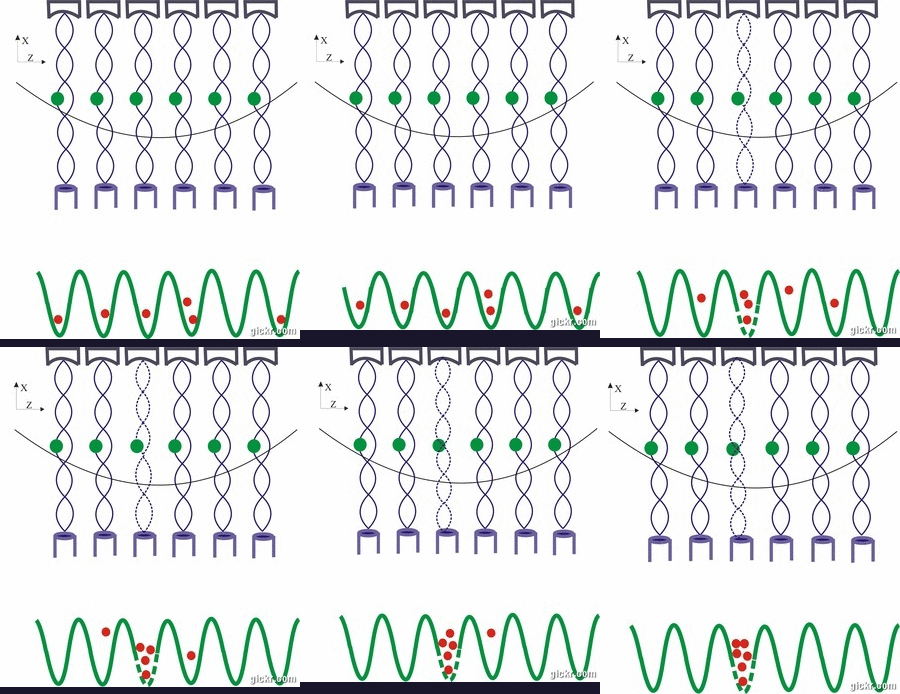
Ramp Dynamics of Phonons in an Ion Trap: Entanglement Generation and Cooling
Ramp dynamics of phonons in a one-dimensional ion trap, using an effective Bose-Hubbard model which describes these phonons at low energies, can be used for both generating multiparticle entangled states and motional state cooling of a string of trapped ions without involving electronic states of the ions. https://journals.aps.org/prl/abstract/10.1103/PhysRevLett.111.170406


High-resolution spectroscopy
Near the 455nm range where a number of important atomic resonance line, the atlas provides no significant data. We have performed high-resolution modulation transfer spectroscopy (MTS) on tellurium molecule in a hot cell in the region close to 455nm wavelength thereby obtained more than 100 new spectral lines which were not observed before. The linewidth of each of these peaks is about a few tens of MHz, making them suitable for laser frequency locking. We find two new Te_2 lines within the 1.2 GHz wide HCL spectrum with the closest one being only 79MHz away from the needed barium line. The closeness of this transition makes it a suitable frequency reference, which can easily be bridged by an acousto-optic modulator.
https://www.osapublishing.org/josab/abstract.cfm?uri=josab-33-6-1177
https://www.sciencedirect.com/science/article/abs/pii/S138614251830917X
